Why You Shouldn’t Buy a Cheap Red Light Therapy Panel
Cheap panels usually emit too little light to have an effect. Studies with positive results use 20 to 100 mW/cm² on the skin, while cheap panels often produce just 5 to 10 mW/cm² at the correct distance. They also often lack clinically relevant wavelengths (at least 660 nm and 850 nm) and valid CE documentation. Below, you’ll learn what to look for and how to recognize a reliable panel.
New red light therapy panels appear every week on Bol.com, Amazon, and AliExpress. €49, €89, €129. Beautiful photos, impressive descriptions, dozens of five-star reviews.
And yet most of these panels do not work.
Not because red light therapy doesn’t work, but because cheap panels simply fail to deliver what they promise.
60-day home trialFree shipping7 years of experience in light therapy
Please note: this information is based on scientific sources, customer experiences and our own knowledge of light therapy. It is not medical advice. If you take medication, have a medical condition or are unsure, talk to your doctor or a specialist first.
The problem: irradiance
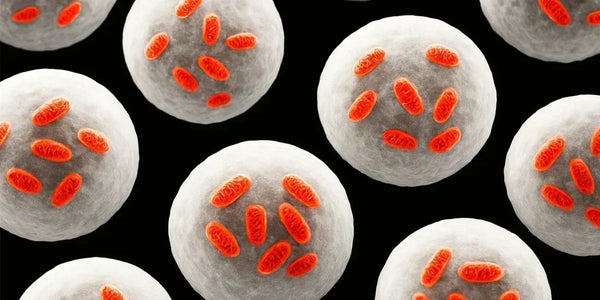
Red light therapy works through a principle called photobiomodulation. Your cells absorb light energy, after which the mitochondria activate the production of ATP (cellular energy), triggering repair processes in muscles, skin, and joints.
But this only works if your cells receive enough energy. That amount of energy, known as irradiance, is measured in mW/cm².
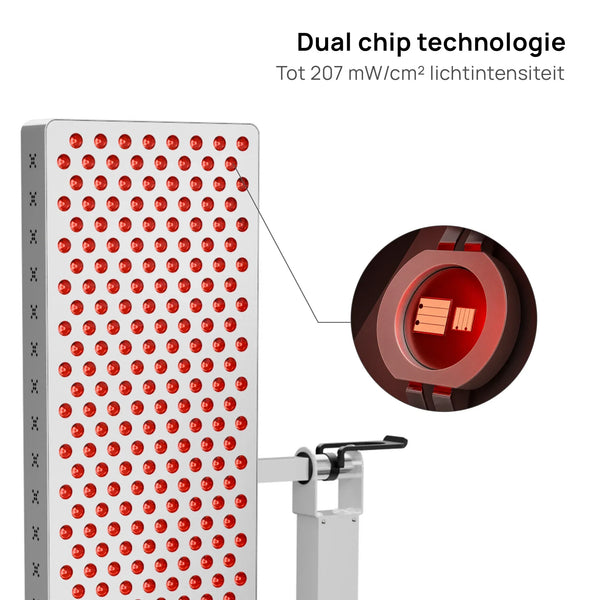
Most scientific studies demonstrating positive effects use an irradiance of 20 to 100 mW/cm² on the skin. Cheap panels often produce just 5 to 10 mW/cm² at the correct distance. You end up sitting in front of a lamp for hours that simply doesn’t do enough.

The problem: wavelength
Not all red light is the same. The effective wavelengths are:
- 630 nm and 660 nm for skin, collagen, and superficial recovery
- 810 nm, 830 nm, and 850 nm for deeper tissues, muscle recovery, reducing inflammation, and supporting joint complaints and rheumatic conditions
Cheap panels often use random wavelengths that look red but have no therapeutic effect. Or they do not specify the wavelengths at all, which should already be a red flag.
The problem: certification
A CE certificate is no guarantee of quality, but its absence is a guarantee of risk. Many cheap panels do not have a valid CE marking, or have applied it illegally. This means no independent safety testing, no controlled electromagnetic emissions, and no guarantee that the LED drivers operate stably and without flicker.
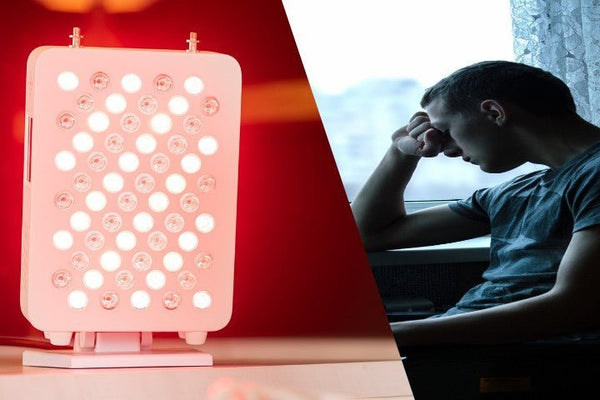
Flicker is not just irritating to your eyes. With intensive use, it can cause headaches and interfere with therapy results.

How do you recognize a reliable brand?
Alongside the technical specifications, there are a few concrete things you can check before buying a panel:
- Ask for the lab tests. A serious manufacturer has its panels independently tested for irradiance, wavelengths, EMF emissions, and flicker levels. These reports should be available, not hidden.
- Check the CE documentation. Not just the logo on the product, but the accompanying Declaration of Conformity with the notified body number. Without this document, the CE marking has no legal value.
- Check whether the specifications are measurable and verifiable. Vague claims such as “powerful LEDs” or “professional quality” without figures are a sign that a brand cannot substantiate its own product.
Liroma publishes lab tests and provides complete CE documentation with every panel (you can find this in the product specifications). Not as a marketing tool, but because transparency is the only way to demonstrate quality.
What you should buy instead
A panel that:
- Has proven irradiance at the correct distance, with measurable specifications
- Uses clinically relevant wavelengths, at least 660 nm and 850 nm
- Is CE-certified with verifiable test documentation
- Has flicker-free LEDs with stable drivers
This is not marketing talk. This is the minimum standard required to achieve any therapeutic effect at all.

The real cost comparison
A €79 panel that doesn’t work costs you €79 plus months of therapy without results.
A quality panel delivers what it promises, lasts five to ten years, and costs you a fraction per effective session of what you would pay a physical therapist or beauty specialist.
Buying cheap means paying dearly. Especially when your health is at stake.
At Liroma, we develop red light therapy panels with clinically relevant wavelengths, measurable irradiance, and official CE certification. Explore our range and read why thousands of customers across Europe choose Liroma.
Want to try it yourself? Explore Liroma’s red light panels. You have 60 days to test at home whether they are right for you.
View the panels