

Op deze pagina

The short answer
An infrared sauna warms your body. Red Light Therapy does not.
In a sauna, your core temperature rises, you sweat, and your heart rate increases. That is exactly the point: your body responds to the heat. Red Light Therapy works through light absorbed by your cells, while your temperature remains unchanged.
That is why one does not replace the other. If you are looking for relaxation and a warmed-up body, heat is the way to go. If you want to target one specific area — a knee, a shoulder, or your skin — a sauna is the wrong tool for the job.

How an infrared sauna works
An infrared sauna does not heat the air, but the objects—and the people—inside it. The panels emit far infrared, or IR-C: wavelengths ranging from 3,000 nm to 1 mm. Water in your skin absorbs this radiation almost immediately, warming your skin, after which the heat spreads through your body.
The cabin is usually between 45 and 60°C, considerably cooler than a Finnish sauna, but the effect is the same: heat stress. Your heart rate increases, your blood vessels dilate, you sweat, and your body produces heat-shock proteins.
This effect has been well studied. A Finnish cohort study followed 2,315 men for more than twenty years and found that more frequent and longer sauna use was associated with a lower risk of cardiovascular disease. The benefit therefore comes from the heat itself, not from a specific wavelength.
If you only want that heat, you do not need to buy a cabin for it. An infrared lamp works on the same principle, for a fraction of the price and space. We explain exactly what the three types of infrared are in IR-A, IR-B and IR-C.

How red light therapy works
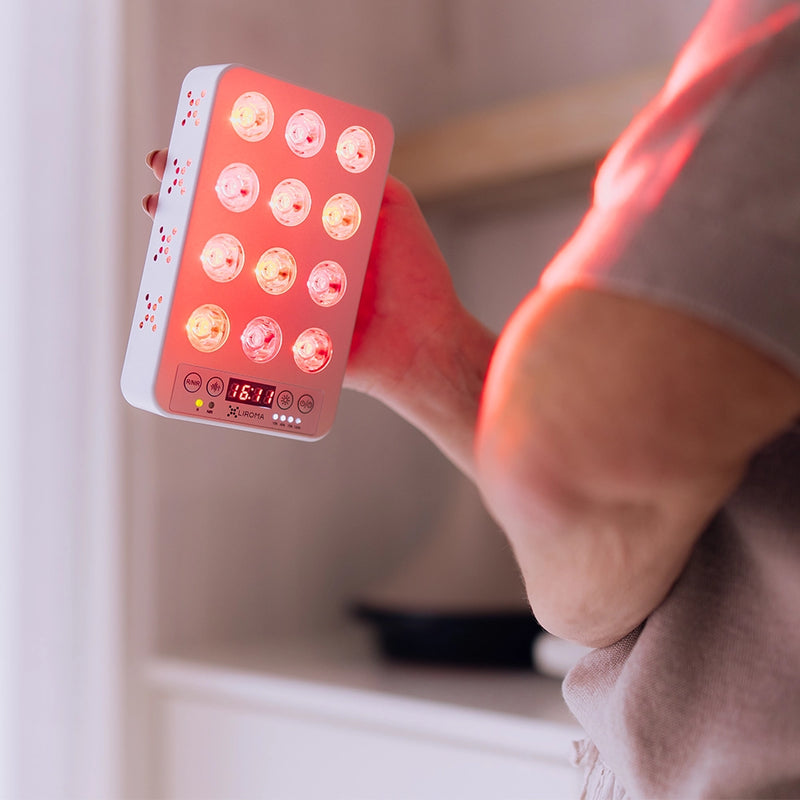
Red Light Therapy — known internationally as photobiomodulation — uses visible red and near-infrared light. The PrimeFORCE Gen5 uses eight wavelengths: 630, 650, 660, 670, 810, 830, 850, and 1060 nm.
That light is absorbed by cytochrome c oxidase, an enzyme in the mitochondria of your cells. This is followed by increased ATP — the fuel that powers your cells — along with changes in nitric oxide and calcium. It generates virtually no heat; your core temperature remains unchanged.
One detail is important: the dose works in a biphasic manner. Too little light does nothing, while too much actually slows things down. Longer or brighter is therefore not automatically better. That is why we publish the measured wavelengths and intensity for each panel instead of a round marketing figure. Which wavelength is used for what is explained in this overview.
Infraroodsauna en rood licht therapie naast elkaar
Ze worden vaak in één adem genoemd, maar ze lopen op vrijwel elk punt uit elkaar. Het verschil begint bij het spectrum en werkt door tot in hoe lang je sessie duurt.
| Infraroodsauna | Rood licht therapie | |
|---|---|---|
| Hoe het werkt | ||
| Werkt via | Warmte | Licht |
| Spectrum | Ver-infrarood (IR-C)3.000 nm – 1 mm | Rood en nabij-infrarood (IR-A)630 – 1060 nm |
| Doordringdiepte | De bovenste huidlaagkomt niet voorbij de hoornlaag | Enkele millimeterstot in spier en gewricht |
| Wat je ervan merkt | ||
| Kerntemperatuur | Stijgt | Blijft gelijk |
| Zweten | Ja | Nee |
| Behandelgebied | Het hele lichaam tegelijk | Een gekozen zone, of het hele lichaam |
| Sessieduur | 20 tot 45 minuten | 10 tot 15 minuten |
| Praktisch | ||
| Wat je kunt meten | Temperatuur, tijd, luchtvochtigheid | Golflengte en intensiteitin mW/cm², per lamp gemeten |
| Wat het aan ruimte kost | Een cabinevaste plek en eigen aansluiting | Een paneelop een standaard of aan de wand |
| Waarvoor mensen het inzetten | Ontspanning en opwarmenhart en bloedvaten | Herstelgewrichten, spieren en huid |

“Full spectrum” and the myth about depth
Many saunas are sold as full spectrum, with the promise that the radiation penetrates centimeters into your body. Optically, that is not correct.
The ICNIRP, the International Commission on Non-Ionizing Radiation Protection, is clear about this: near-infrared (IR-A) penetrates a few millimeters into tissue, while far-infrared (IR-C) remains in the upper layers of the skin—it does not get beyond the stratum corneum. Water in your skin absorbs those long wavelengths almost immediately.
It is true that a sauna still warms you all the way to your muscles. But this happens through conduction and increased blood flow, not because the light itself penetrates that deeply.
The practical difference: with a sauna, temperature, humidity, and time matter. With red light therapy, what matters is which wavelengths come from the panel and how much. That is measurable—and those are precisely the measurements most manufacturers do not publish. We do: a separate measurement report for each wavelength, plus the CE documents in our own name.

Can you combine them?
Yes. They don’t interfere with each other—they simply do different things.
You often read that it’s better not to use them at the same time because a sauna puts stress on the body, while red light supports recovery. To be honest, that’s mainly speculation rather than evidence: there’s still no solid research comparing the combination with either one separately. Michael Hamblin, one of the most frequently cited researchers in this field, pointed out in 2022 that the two mechanisms do in fact partly overlap.
What does matter in practice is that a red light therapy panel requires ten to fifteen minutes at a fixed distance from your skin. That doesn’t work well with sweating and moving around in a sauna cabin. So it’s better to use the panel in the living room or bedroom, and keep the sauna for the sauna. You can find out how often and for how long to use it in this usage guide; the correct distance is explained in this article.
Waar wordt het voor gebruikt?
Allebei worden ze om gezondheidsredenen gekozen, maar niet om dezelfde. Hieronder staat per behandeling waar mensen ze voor inzetten, en waar dat op gebaseerd is. Waar het bewijs dun is, zeggen we dat erbij.
Infraroodsauna
Werkt via warmte
- Hart en bloedvatenHier is het bewijs het sterkst. Een Fins cohort van 2.315 mannen, ruim twintig jaar gevolgd, liet zien dat vaker en langer saunabezoek samenhing met een lager risico op hart- en vaatziekten.
- Ontspanning en stressDe meest genoemde reden om te gaan. De hitte verlaagt spierspanning en geeft je een halfuur waarin je niets hoeft.
- Soepeler worden na inspanningWarmte verhoogt de doorbloeding en maakt spieren losser. Handig ná het sporten, niet als vervanging van herstel.
- Wat je erbij moet wetenHet effect komt van de wármte, niet van een bepaalde golflengte. Een sauna die zich “full spectrum” noemt, doet op dit punt niets extra's.
Rood licht therapie
Werkt via licht
- HuidDe best onderzochte toepassing. Rood licht rond 630 tot 670 nm wordt in de bovenste huidlagen opgenomen en wordt ingezet bij collageenaanmaak, littekens en huidveroudering.
- Spierherstel en vermoeidheidEen systematische review met meta-analyse onder gezonde mensen vond dat lichttherapie spiervermoeidheid uitstelt en het herstel ondersteunt, vooral toegepast vóór de inspanning.
- Gewrichten en spierenNabij-infrarood van 810 tot 1060 nm komt enkele millimeters het weefsel in. Daarom wordt het gebruikt bij plaatselijke klachten: een knie, een schouder, de onderrug.
- Wat je erbij moet wetenDe dosis werkt tweefasig: te weinig licht doet niets, te veel remt af. Langer of feller is dus niet beter — daarom publiceren wij de gemeten intensiteit per paneel.
What this page is based on
Twenty years, 2,315 men
A Finnish cohort was followed for more than twenty years. More frequent and longer sauna use was associated with a lower risk of sudden cardiac death and cardiovascular disease. The review article in Mayo Clinic Proceedings brings this together with the rest of the sauna research.
Read the overviewWhat light does in the cell
Hamblin describes how cytochrome c oxidase absorbs light, leading to increased ATP, a brief burst of oxygen radicals, and a shift in nitric oxide. The biphasic dose response also stems from this: too much light has the opposite effect.
Read the articleIR-A penetrates deeper than IR-C
ICNIRP establishes that near-infrared penetrates several millimeters into the tissue, while far-infrared is absorbed in the upper layers of the skin and does not pass beyond the stratum corneum. This invalidates the claim that far-infrared penetrates several centimeters deep.
View the ICNIRP pageWhat do they have in common?
In 2022, Hamblin examined the overlap between saunas and photobiomodulation. His conclusion is more nuanced than the simple “don’t combine them” advice often found online.
View on PubMedMuscle performance and recovery
A systematic review with meta-analysis in healthy people found that light therapy delays muscle fatigue and supports recovery after exercise, especially when applied before exercise.
View on PubMedWe refer to the original research so you can read for yourself what has and has not been demonstrated. Red Light Therapy and sauna use are supportive and not a substitute for medical care.
Not satisfied? Your money back.
Tailored to your complaint and the panel you choose.
Reviewed by more than a thousand customers.
Sauna, infrared, and red light
Is an infrared sauna the same as red light therapy?
No. An infrared sauna uses far-infrared light to generate heat and raise your core temperature. Red Light Therapy uses red and near-infrared light that is absorbed by your cells without making you warmer. They are two different treatments that happen to both include the word infrared.
Do I also get red light therapy in an infrared sauna?
Usually not. Most saunas emit primarily far-infrared radiation, which falls outside the range in which red light therapy works. Some cabins include a red light or a small panel, but then the question is how much light reaches your skin and at which wavelengths. Always ask for a measurement report; if they cannot provide one, you simply do not know.
This is what a measurement report looks likeDo I get warm from a red light therapy panel?
You feel a gentle warmth on your skin, similar to sunlight through a window. Your core temperature doesn’t change, and it won’t make you sweat. That’s exactly the difference from a sauna: there, the heat is the active element; with a panel, it’s the light.
I already have an infrared sauna. Do I still need a panel?
It depends on what you want to achieve. For relaxation, warming up, and the effects on your heart and blood vessels, your sauna is all you need. If you’re looking for targeted support for one area—a knee, a shoulder, your lower back, or your skin—a sauna won’t do that. You can aim a panel at that specific area for ten to fifteen minutes without having to sweat.
Compare the panelsCan I use them on the same day?
Yes, that’s perfectly fine. There is no research showing that the combination is harmful or counterproductive. In practice, it’s most convenient to do them separately: a panel session requires a fixed distance and a relaxed posture, which is difficult to combine with sweating in a cabin.
Which wavelengths do I need?
For the skin, red wavelengths around 630 to 670 nm work best because they are absorbed in the upper layers of the skin. For muscles and joints, you need near-infrared light, roughly 810 to 1060 nm, because it penetrates deeper. The PrimeFORCE Gen5 combines eight wavelengths, so you don’t have to choose.
Everything about wavelengthsIs an infrared lamp the same as an infrared sauna?
In practice, yes: both generate heat using infrared. The difference is the scale. A sauna heats an entire cabin and, with it, your whole body; an infrared lamp focuses that heat on one area. If you want the warming effect without the cabin and the expense, a lamp is the practical option.
View the infrared lampsWhy do some saunas call themselves “full spectrum”?
Because they also claim to emit near- and mid-infrared radiation in addition to far-infrared. That is possible in itself, but the term says nothing about how much light is emitted at each wavelength. Without a measurement for each wavelength, “full spectrum” is a marketing term, not a specification.
Still unsure whether you want warmth or light?
Tell us what’s bothering you and we’ll tell you honestly whether a panel is a good match. Feel free to call us at 026 2022285, or first put the panels side by side yourself by treatment area, wavelength and irradiance.
Compare the panelsRed light therapy is intended to support the body’s natural recovery and is not a medical device for treating conditions. Results may vary from person to person. If you have persistent, severe, or radiating back pain, neurological symptoms, or a fever, always consult your doctor first.

