Is red light therapy nonsense? An honest answer
“Isn’t that just an expensive lamp?” It’s a fair question, and it’s asked more often than you might think. Below, you’ll read where the doubt comes from, what the research shows, and what you can realistically expect from it.
We sell these devices. That is a vested interest, and you may read this article with that in mind. We have tried to explain where the evidence is strong, where it is thin, and which claims we do not make ourselves - because there are some.
60-day home trialFree shipping7 years of experience in light therapy
Please note: this information is based on scientific sources, customer experiences and our own knowledge of light therapy. It is not medical advice. If you take medication, have a medical condition or are unsure, talk to your doctor or a specialist first.
First: where the skepticism comes from
There are three good reasons to be skeptical.
The claims go too far. You come across providers who link red light to hair growth, weight loss, better sleep, less pain, firmer skin, and more energy - all at once. A treatment that does everything usually does nothing.
The term has become muddled. “Infrared” is used for a thirty-euro heat lamp and for a measured panel costing a thousand euros. Those are different things, and we explain the difference in infrared or red light.
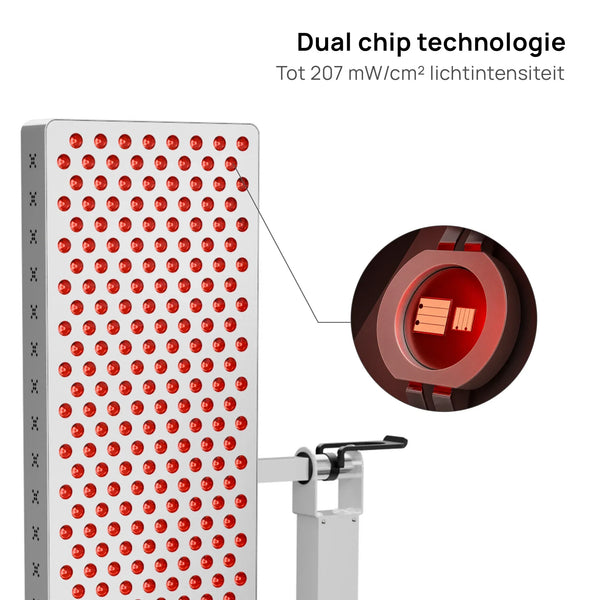
Almost nobody publishes figures. Ask a seller how much light comes out of the panel, at what wavelength, and at what distance, and you rarely get an answer. Without those figures, a lamp is just a box that glows red.
What there is evidence for
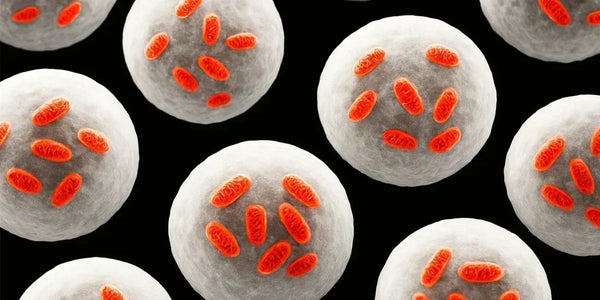
Red light therapy is called photobiomodulation in the literature, and its mechanism has been described. Light around 600 to 1000 nanometers is absorbed by cytochrome c oxidase, an enzyme in the mitochondria. This is followed by increased ATP, a brief spike in oxygen radicals that acts as a signal, and a shift in nitric oxide.
Michael Hamblin, one of the most frequently cited researchers in this field, explains this in his overview of the mechanisms of action. This is not fringe science: it appears in peer-reviewed literature and is widely cited.
A mechanism alone, however, is not the same as a proven result in your home. That step is exactly where things get interesting.
Where the evidence is strongest
Muscle recovery and fatigue. This is where the evidence is strongest. A systematic review with a meta-analysis of healthy people found that light therapy delays muscle fatigue and supports recovery after exercise - especially when applied before exercise. This is a meta-analysis, not an isolated study, and that carries more weight.
Skin. The most studied application, using red light around 630 to 670 nm. It concerns collagen processes and skin recovery. See light therapy and collagen.
Where the evidence is thinner
Here, we deliberately state what we cannot substantiate firmly.
- Weight loss. We do not claim this. Period.
- Hair growth. There is research, but the quality varies considerably and the effects are modest.
- Sleep and mood. Plausible through circadian rhythms, but the research is small-scale and mixed.
- Joints. In the case of a knee, near-infrared penetrates several millimeters into the tissue according to the ICNIRP - physically plausible, then. In the case of a hip, with centimeters of muscle and fat in between, that explanation becomes considerably more difficult. We prefer to mention that too.
Why “more is better” is actually a warning sign
If someone tells you that longer or brighter always works better, that person does not know what they are talking about.
The dose actually works in a biphasic way: too little light does nothing, more light helps up to a certain point, and beyond that the effect decreases again. This is one of the best-documented properties of photobiomodulation - and at the same time one of the most ignored in sales.

The question that decides everything
Whether it works for you depends mainly on whether your device delivers the right dose. That is why it always comes down to one question for the seller:
How many mW/cm² does this panel deliver, at what distance, and for each wavelength?
If you do not get an answer, then the discussion of whether red light therapy works is not even relevant - because nobody knows what that device does. We publish our measurements for each wavelength on the certificates page, and explain in how many mW/cm² you need how to interpret that figure.
So: nonsense or not?
No, not nonsense. But it is not a miracle cure either, and certainly not a replacement for exercise, sleep, or medical care.
What it is: a treatment with a described mechanism, reasonable evidence for muscle recovery and skin, thinner evidence for the rest, and a result that depends entirely on using the right dose and sticking with it. Anyone who does ten minutes four times a week gives it a fair chance. Anyone who is enthusiastic for two weeks and then stops does not.
That is why you can try it at home with us for sixty days. Not as a sales trick, but because this is a treatment whose effect on you is something you have to determine for yourself.
Sources
- Hamblin, M. - Mechanisms and Mitochondrial Redox Signaling in Photobiomodulation
- Systematic review and meta-analysis: light therapy, muscle fatigue, and recovery
- ICNIRP - Infrared radiation
- Liroma - measurement reports by wavelength and irradiance per model
Red light therapy is intended to support natural recovery and is not a medical device for curing conditions. Results vary from person to person.