Red light therapy for knee pain and knee osteoarthritis
The knee is the joint people email us about most often. That makes sense: it is the largest joint in your body, it carries your entire weight, and osteoarthritis affects the knee more often than any other joint. Below, you can read how red light therapy is used for knee complaints and what to pay attention to.
This article is about what red light therapy can mean for a knee — and where its limits lie. We sell these devices, so read it with that in mind. We have made an effort to also explain what it does not do.
60-day home trialFree shipping7 years of experience in light therapy
Please note: this information is based on scientific sources, customer experiences and our own knowledge of light therapy. It is not medical advice. If you take medication, have a medical condition or are unsure, talk to your doctor or a specialist first.
First: when you should not start here
Red light therapy is supportive and is not a diagnosis. See your doctor first if you have:
- a knee that suddenly becomes swollen, warm or red;
- pain after a fall, twisting movement or blow;
- a knee that locks or gives way;
- a fever as well.
Thuisarts.nl has a clear page about osteoarthritis in the knee explaining what you can do yourself and when to seek help. Read it first if you do not have a diagnosis yet.
What happens in an osteoarthritic knee
With osteoarthritis, the cartilage in the joint becomes thinner and rougher. As a result, the ends of the bones move less smoothly against each other, causing pain, stiffness and sometimes a grinding sensation. The surrounding tissue often becomes irritated as well.
What is important to know: osteoarthritis cannot be cured. There is no treatment — not even a lamp — that can restore cartilage. What you can do is target the symptoms around it: pain, stiffness and how smoothly you move.
Why the knee is particularly suitable for light therapy

A knee has one practical advantage over almost any other joint: there is little in the way. No thick muscle layer, no significant fat layer. The joint lies just beneath the skin.
That matters because light does not travel far. According to the ICNIRP, near-infrared penetrates a few millimeters into the tissue, while far-infrared remains in the upper layers of the skin. With a hip, where centimeters of muscle and fat lie over it, that is a difficult proposition. With a knee, much less so.
Which wavelengths you need
For a joint, you need near-infrared, roughly 810 to 1060 nm. This is the group that reaches the deepest.
Red light from 630 to 670 nm is absorbed in the upper layers of the skin. That is fine for the skin, but for a joint it is not what you should rely on. A panel that emits only red light is the wrong choice for a knee.
The PrimeFORCE series combines eight wavelengths, including 810, 830, 850 and 1060 nm, so you do not have to make that choice. More about which wavelength is for what can be found in the wavelength overview.
How to treat a knee in practice
A knee is round, and that is the key point. Light coming straight from the front barely reaches the sides.
- Distance: thirty to fifty centimeters. Closer is not better; see the article about distance.
- Duration: eight to twelve minutes per side. Stay under twenty minutes per zone.
- Treat multiple sides. Front, inner side, outer side. That is three short sessions instead of one long one.
- Bare skin. Light does not pass through a trouser leg.
- Frequency: four to five times per week. See how often you should do it.
Which device is right for a knee?

For just one knee, you do not need a two-meter panel. Three options:
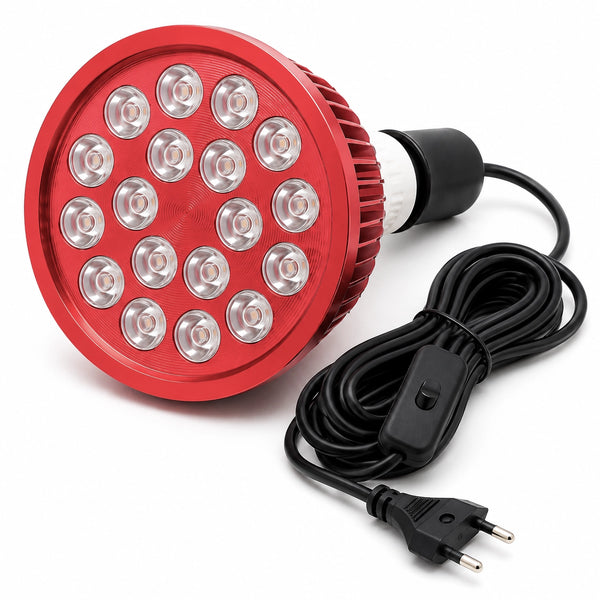
- The PrimeSpot is designed for one spot, making it the most practical choice if your knee is the only concern.
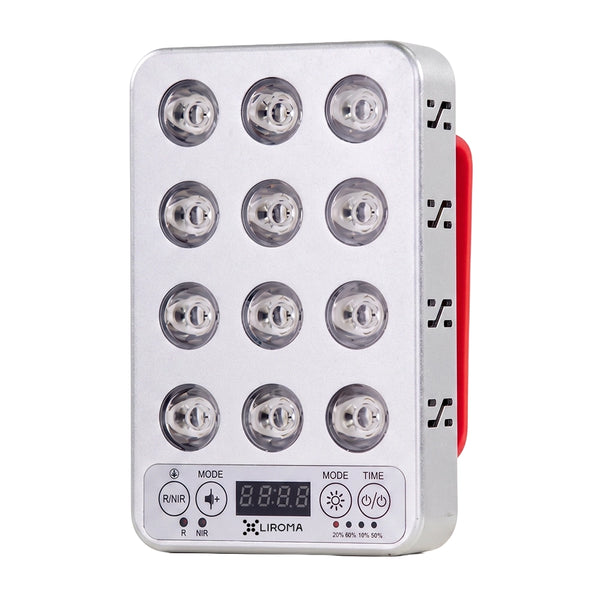
- The Portable Prime is small and portable, which is useful if you also want to treat a shoulder or elbow occasionally.
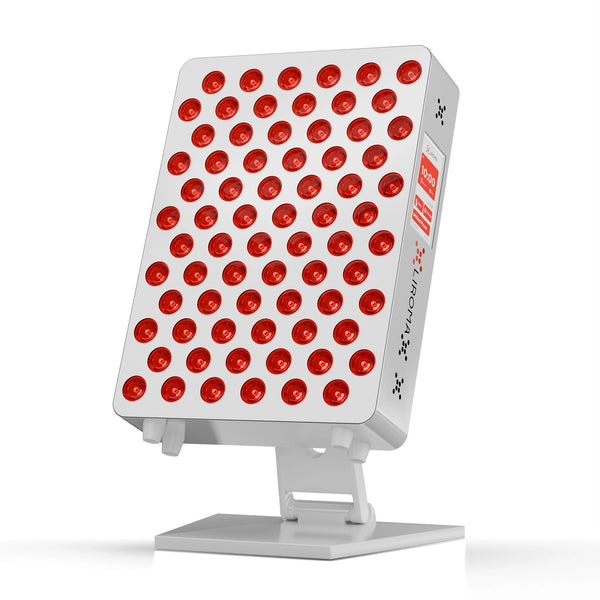
- A panel such as the Compact or Advanced becomes interesting when more is involved than just the knee — you can also use it on your lower back or neck.
Not sure? Use the product selection guide or compare the models side by side.
What you can realistically expect
No restored cartilage. But for some users, less stiffness in the morning and easier movement throughout the day. That is not a cure, but with a condition you carry for years, it is still worthwhile.
Expect a gradual start. You usually notice little during the first few weeks; most people who notice an effect notice it after three to six weeks of consistent treatment. What you can expect during that period is explained in how long it takes to see results.
If nothing has changed after eight weeks, it probably is not working for you. That happens, which is why you can try it at home with us for sixty days.
Combining it with the rest
Light does not replace movement. With knee osteoarthritis, muscle strength around the joint is one of the few things proven to help; your physiotherapist or doctor can help you get started. Think of red light therapy as something to use alongside this, not instead of it.
Read more about light therapy for osteoarthritis in general in infrared and red light for osteoarthritis.
Sources
- Thuisarts.nl — Osteoarthritis in your knee
- Thuisarts.nl — Osteoarthritis: what is it, where does it occur, and what helps?
- ICNIRP — Infrared radiation
- Hamblin, M. — Mechanisms and Mitochondrial Redox Signaling in Photobiomodulation
Red light therapy is intended to support the body's natural recovery and is not a medical device for curing conditions. Results vary from person to person. Always consult your doctor first if symptoms persist or are severe.